As the ocean community gathered in Nice for the 2025 UN Ocean Conference (UNOC3) in June, the Integrated Marine Debris Observing System (IMDOS) reaffirmed its role as a vital global initiative dedicated to advancing coordinated marine debris monitoring.
Launched after the OceanObs’19 Conference, IMDOS is a joint initiative of the Global Ocean Observing System (GOOS) and GEO Blue Planet, and a partner of the UNEP Global Partnership on Plastic Pollution and Marine Litter (GPML). It supports the development of a global marine debris monitoring system that can inform research, the private sector, and policy and decision-makers.
With momentum building for action on plastic pollution, we look back at some of the key moments for IMDOS at UNOC.
A collective commitment

IMDOS’s Advisory and Sponsors Committee members who signed the IMDOS Declaration of Common Purpose (from left to right): Francois Galgani (GESAMP), Joanna Post (GOOS), Jana Friederich (International Atomic Energy Agency), Audrey Hasson (GEO Blue Planet), Alexander Turra (University of São Paulo), Daphné Lecillier (GEO Blue Planet), Marc Metian (IAEA-NUTEC), and Evgeniia Kostianaia (IOC-UNESCO)
Collaboration and cooperation form the foundation of IMDOS’s approach to delivering harmonised and impactful marine debris data worldwide. On June 11, the ten members of IMDOS’s Advisory and Sponsors Committee formalised their shared dedication by signing the IMDOS Declaration of Common Purpose at the EU Digital Ocean Pavilion. The declaration represents a shared commitment to harmonise monitoring efforts, close knowledge gaps, and deliver accessible, reliable data to a wide range of users. The signing event included a presentation by the new IMDOS co-chair, Professor Alexander Turra (University of São Paulo), a report back from the Combatting Marine Pollution, Including Plastics, Through Innovative International Action high-level event held in the Blue Zone on June 10, and a speech from the IMDOS Advisory and Sponsors Committee.


The Combatting Marine Pollution, Including Plastics event, held by the International Atomic Energy Agency in collaboration with Surfrider Foundation Europe, European Environment Agency, Mercator Ocean International, NORMAN Network, Environmental Investigation Agency, International Scientist’s Coalition for an Effective Plastics Treaty, UNEP, and Costa Rica demonstrated how ambitious global environmental policies, innovative technologies, international networks and capacity building can jointly lead to a zero-pollution ocean.
Separately, the European Union announced a new voluntary commitment under the European Ocean Pact to support the development of a global marine litter monitoring system. This commitment further anchors IMDOS within wider international governance efforts and strengthens the initiative’s potential for long-term impact.
On June 12, the IMDOS Steering Committee convened for its second in-person meeting. The Committee comprises representatives from 20 leading research institutions across 13 countries, alongside key global partners. Building on their inaugural meeting in January 2025, this session brought together 11 of the 30 members in person, with the remainder joining remotely.
During the meeting, members reviewed progress reports from Task Teams, discussed plans for upcoming online meetings in 2025 and the next in-person gathering scheduled for 2026, and explored new funding opportunities to support IMDOS’s growth.
The IMDOS Secretariat also warmly welcomed its newly elected Co-Chairs: Dr Amy Lusher (Norwegian Institute for Water Research (NIVA)) and Professor Alexander Turra. Amy is a Senior Research Scientist at NIVA with extensive experience shaping monitoring guidelines for intergovernmental organisations. Alexander is a Professor at the University of São Paulo, UNESCO Chair for Ocean Sustainability, founder of Brazil’s Clean Ocean Network, and Co-Chair of the UN Ocean Decade Advisory Board. Their leadership will be pivotal in steering IMDOS toward achieving its global monitoring goals.
Following the Committee meeting, a group of experts, policymakers, and partners gathered for an official Side-Event organised by the GEO Blue Planet EU Office and the Institute of Oceanology, Policy Academy of Sciences (IO PAN) and funded by the European Commission through the EU4OceanObs project, implemented by Mercator Ocean International. The focus – Driving Change with Data: The Integrated Marine Debris Observing System.
Tailored for a non-technical audience, the Side-Event, which was hosted at the Mama Shelter and saw over 50 in-person participants and around 40 online, highlighted the initiative’s vision and missions, showcased three successful international collaborations, and explored how harmonised data and monitoring systems support marine litter policies worldwide.
A key focus of the Side Event was the recognised need and setup of monitoring systems under the forthcoming UN global treaty on plastic pollution. Once the Treaty is adopted, countries will need to report on their progress and implement effective measures to combat plastic pollution. Robust monitoring systems, backed by scientific advice and capacity-building, will be essential to support these obligations.
Data that drives change
At the Driving Change with Data: The Integrated Marine Debris Observing System Side Event, participants emphasised the importance of reliable, global-scale datasets to inform evidence-based policy. To be effective, these datasets must be built on sustained and standardised monitoring, capable of identifying long-term trends and patterns.
Participants highlighted the role of simple, cost-effective methods, supported by evolving technologies such as apps, drones, and video surveillance. Technology transfer and co-development were emphasised as essential to ensure tools are usable and effective across different national and local contexts and that they meet the user’s needs.
Turning data into action was another key theme. Robust, unbiased information can inform policy advice, guide implementation plans based on measurable indicators, and track progress over time. By establishing a monitoring plan, setting a baseline, and tracking changes, countries can assess the success of actions and adjust strategies accordingly. Participants also discussed including rivers, as they are estimated to be the source of up to 80% of marine debris, in monitoring systems. Among the inspiring examples of delivering data for action came from Dr. Georg Hanke (DG JRC, European Commission) talk “Monitoring litter to inform decision-making.”
Building a shared monitoring system
Given the global, transboundary nature of marine litter and the diverse types and sources of pollution, participants stressed the need for a co-designed, multisectoral dialogue supported by a wide range of data sources. For example, Vitoria Scrich (UNESCO Chair for Ocean Sustainability) and Professor Alexander Turra (University of Sao Paulo) presented Collaborative “Governance for Marine Litter Monitoring in Brazil,” and Dr. Marc Metian (IAEA-NUTEC) presented “Harmonization of Monitoring and Assessment of Plastic Pollution.”
There is a growing need for national and global datasets to follow common protocols, supported by secure repositories and interoperability with other systems. Repositories should not only store information but also safeguard long-term access and data integrity.
Participants underlined the importance of aligning datasets through federated systems and shared methodologies. Existing guidance from initiatives and organisations such as the OSPAR Commission, the EU Commission, and GESAMP (the Joint Group of Experts on the Scientific Aspects of Marine Environmental Protection) provides a starting point.
Linking with existing platforms, including the UN SDG Global Database, the Global Plastic Hub, UNdata, NOAA, EMODnet, and the Atlas of Ocean Microplastics (AOMI), was also discussed as a key step in ensuring compatibility and comparability across systems.
Marine plastics at the EU Digital Ocean Pavilion
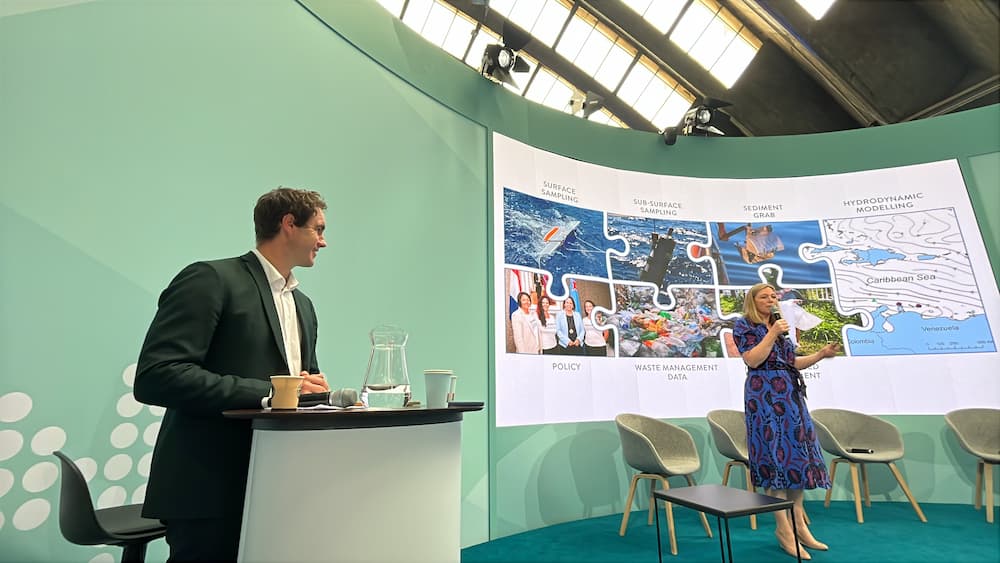
Caption: Emily Penn (eXXpedition) delivers a talk about citizen science for marine pollution
At the EU Digital Ocean Pavilion, which was held in the Green Zone, marine plastic pollution was a key theme.
The EDITO-Model Lab Marine Plastic Tracker application was presented at EU Digital Twin Ocean (EU DTO), while a three-hour session dedicated to marine pollution featured talks from Christopher Corbin (Cartagena Convention Secretariat, United Nations Environment Programme) on the Global Plastics Hub of the Global Partnership on Plastic Pollution and Marine Litter (GPML), Dr Georg Hanke (DG JRC, European Commission) gave a plea to “get started” on global monitoring of plastic/marine litter, and keynote Emily Penn (eXXpedition) spoke about the role of citizen science monitoring.
Finally, IMDOS steering committee member Dr Giuseppe Suaria won 2nd place in a photo contest organised at the EU Digital Ocean Pavilion for his photo “Cold Lights!”