
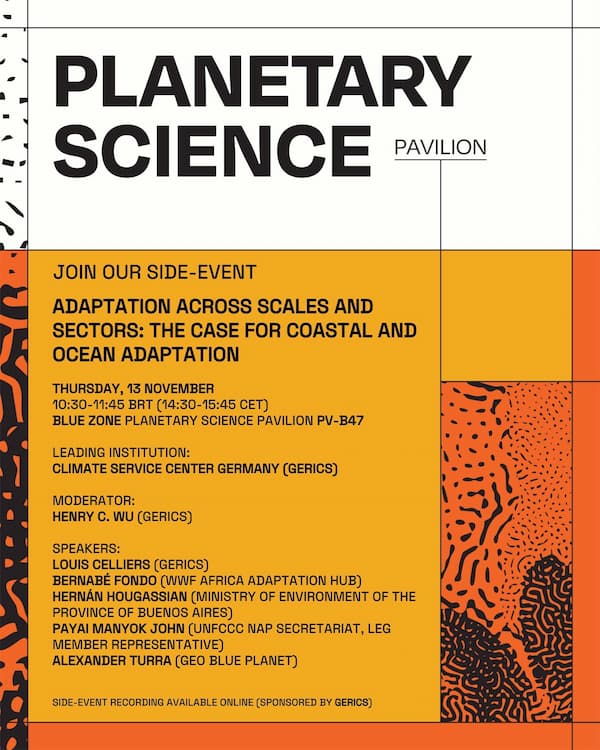
COP30 Side-event “Adaptation across scales and sectors: the case for coastal and ocean adaptation”
Location: Blue Zone, Planetary Science Pavilion (PV-B47), Belém, COP30 Brazil
Date: 13 November 2025
Time: 10:30 – 11:45 Brazilian Time (14h30-15h45 CET)
Faciliator: Henry Wu (Climate Service Center Germany)
Panelists:
- Louis Celliers (GERICS), PhD
- Alex Turra (GEO Blue Planet)
- Payai Manyok John (UNFCCC NAP Secretariat, LEG member)
- Karen Silverwood-Cope (WRI Brazil)
- Bernabé Alexandre Fondo (WWF Africa Adaptation Hub, WWF Mozambique)
The Sustainable Development Goals (SDGs) and the UN Decade of Ocean Science highlight the vital role of oceans and coasts in advancing sustainable development, particularly for coastal and blue economies. Coasts are complex social-ecological systems, and their relationship with climate change is equally multifaceted. Yet, coastal and ocean spatial planning – which includes urban, rural, and marine dimensions – is often neglected in National Adaptation Plans (NAPs), despite its importance in identifying medium- and long-term adaptation needs.
Effective coastal adaptation and transformation require coordinated action at both national and sub-national levels. Although progress has been made, significant information gaps remain, especially in Africa, regarding the impacts of climate change on coastal areas.
If the UNFCCC NAP objectives were tailored to coastal and ocean economies, they would aim to a) reduce the vulnerability of coastal communities and ecosystems to climate change; b) build adaptive capacity and resilience; and, c) integrate climate adaptation coherently into new and existing coastal policies, programs, and development strategies across all relevant sectors and governance levels.
From a coastal perspective, NAPs should offer a systematic, evidence-based, and coordinated approach to climate preparedness. This includes addressing risks arising from the interaction of climate change, natural variability, and human pressures on coasts; and minimizing or avoiding negative impacts on coastal human and ecological systems.
Given the complexity of adaptation options, there is a clear need for practical guidance and advanced decision-making frameworks that consider local-scale dynamics through national and sub-national planning. Similarly, the integration of data an information (e.g., formal, scientific, local and indigenous) presents challenges that must be overcome for adaptions efforts to focus on actions that will result in resilient coastal communities.
The objectives of this session are to: a) provide pragmatic solutions to create an intersection between national adaptation planning, and sub-national adaptation actions in the ocean and coastal domain, b) demonstrate the need and solutions for integrating different forms of data and information into planning and implementation.
Both processes are critically important but there are significant challenges to integrate planning and implementation of adaptation priorities on the coast, especially in the LDCs and SIDS.
More informations:
The Conference of the Parties (COP) is the largest global United Nations event for discussions and negotiations on climate change in the framework of the UNFCCC. The meeting is held annually, with the presidency rotating among the five UN-recognized regions.
In 2025, Brasil will host the 30th Conference of the Parties (COP30), which will take place in Belém, Pará. The chosen city will provide the world with a unique platform to discuss climate solutions, firmly rooted in the heart of the Amazon. As the host country, Brasil is committed to strengthening multilateralism and the implementation of the Paris Agreement.
GEO Blue Planet and its partner HERON-GERICS are co-organizing a side-event (onsite and online) at the « Planetary Science » pavilion, which is mandated by the COP30, to discuss and promote the Ocean & Coastal Adaptation to Climate Change Guide for National Adaptation Plans launched during NAPExpo in August 2025 in Zambia. More information coming soon about the panel speakers, program and dates.