
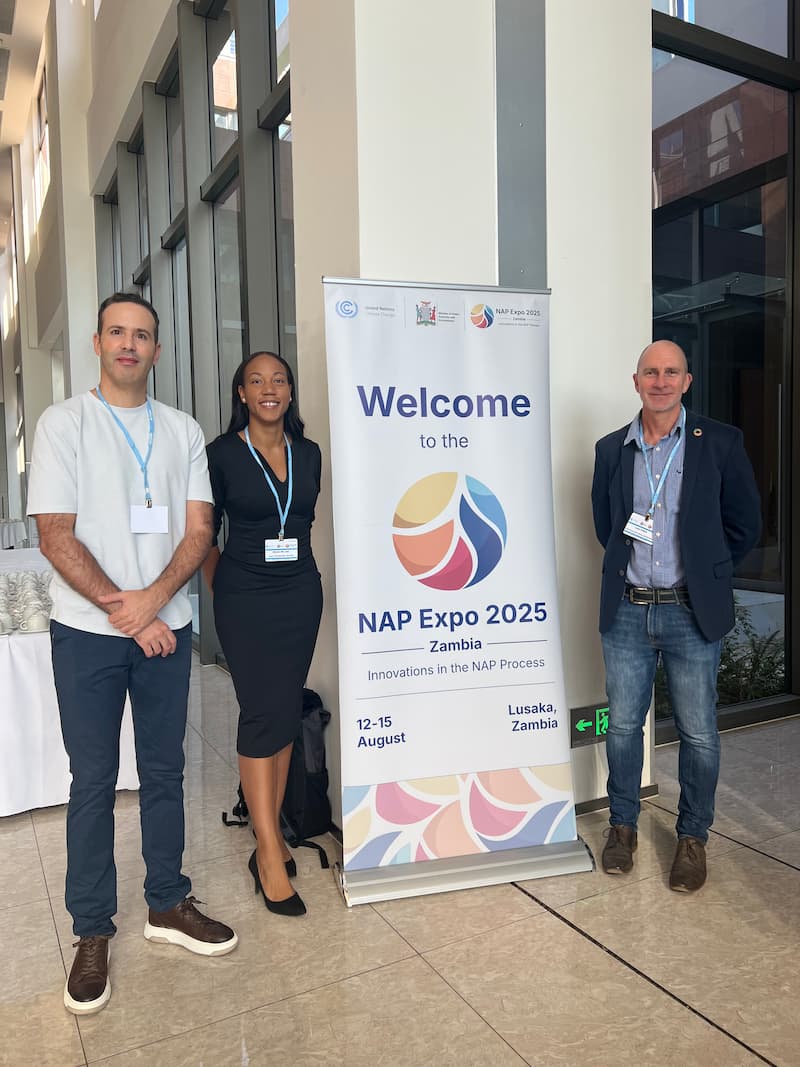
 At the 2025 National Adaptation Plan (NAP) Expo in Lusaka, Zambia, coastal and ocean adaptation was prominently featured in discussions. A dedicated workshop brought together ministerial representatives and technical experts from Least Developed Countries (LDCs), Small Island Developing States (SIDS), and other coastal nations to share experiences and priorities. Co-organised by the Climate Services Center Germany (GERICS–Hereon) and GEO Blue Planet, with support from Mercator Ocean International and the EU4OceanObs programme, the session provided a platform for countries to exchange experiences, identify gaps, and explore how ocean and coastal issues can be better integrated into national adaptation processes.
Highlighting the urgency of coastal resilience
Opening the session, Louis Celliers, Senior Coastal Scientist at GERICS-hereon, emphasised the global significance of ocean and coastal systems to human development. The “gross marine product” is estimated at US$2.5 trillion annually, with the total asset value of the ocean reaching at least US$24 trillion. Additionally, almost half the world’s population lives in coastal areas that are increasingly vulnerable to sea-level rise, extreme weather, and ecosystem degradation.
Celliers underscored that 31 coastal Least Developed Countries (LDCs)—representing more than 87% of the group—fall in the top half of global vulnerability rankings. He stressed that including oceans and coasts in National Adaptation Plans is essential not only for resilience but also for sustaining livelihoods and the Blue Economy.
Assessing progress and identifying gaps
David Cabana, also a Senior Coastal Scientist at GERICS, presented an overview of the current state of coastal and ocean adaptation in NAPs. Of the 27 coastal LDCs, only 11 have submitted their plans, and among 57 SIDS, just 10 have done so. Crucially, only two countries (Brazil and Uruguay) currently include dedicated coastal and ocean sectoral adaptation components.
Cabana explained that the new 2025 Supplementary Material on Coastal and Ocean Adaptation was developed to address this gap. It provides practical guidance to help nations at different stages of the NAP process incorporate marine and coastal priorities into adaptation planning.
Country perspectives: challenges and innovation
The session, chaired by Nikelene McLean, Programme Officer at GEO Blue Planet, featured country representatives sharing their experiences with coastal and ocean adaptation.
Jauza Khaleel, Senior Climate Adaptation Expert in the Maldives, described the country’s extreme exposure to sea-level rise and the proximity of critical infrastructure to coastal hazards. Adaptation investments range from hard defences, such as seawalls and breakwaters, to softer, nature-based approaches, including beach replenishment and coastal vegetation restoration.
Adão Soares Barbosa, Special Envoy with the category of Ambassador at large for Climate Affairs in Timor-Leste, outlined progress in mainstreaming coastal adaptation into national frameworks, supported by Green Climate Fund investments in mangrove rehabilitation and flood resilience. He emphasised the link between coastal protection and the emerging Blue Economy.
Gabriel Kaparka, Deputy Director General and UNFCCC Focal Point at the Ministry of Environment and Climate Change in Sierra Leonne stressed the economic and social importance of the country’s 250-mile coastline and shared lessons from recent coastal management projects, which focus on data collection, institutional coordination, and community engagement.
Isoufa Fouad Ali, Minister for Environment, Climatology and Disaster Management in Comoros, highlighted integrated efforts combining ecosystem restoration and infrastructure resilience, supported by GEF and regional development initiatives.
Overcoming barriers and building capacity
In an interactive discussion facilitated by David Cabana, participants identified persistent barriers to coastal and ocean adaptation. The high cost of implementing interventions remains a major challenge. The Maldives, for example, already dedicates about 35% of its national budget to adaptation.
Across countries, participants cited limited technical capacity, gaps in data and monitoring tools, and fragmented institutional responsibilities as major constraints. Delegates called for more fine-scale, island-specific data and capacity development in areas such as climate modelling, sea-level monitoring, and ecosystem-based adaptation.
Representatives from Sierra Leone and Timor-Leste emphasised the value of partnerships with technical organisations like GERICS and GEO Blue Planet to build national expertise and strengthen governance. WWF Africa and other contributors highlighted the importance of recognising coasts and oceans not only as vulnerable systems but also as nature-based solutions for climate resilience.
Next steps: sustaining momentum
The need for the Supplementary Material on Coastal and Ocean Adaptation was strongly confirmed during the workshop. However, participants noted that its practical application has yet to be tested. This will need to be explored at the country level, and both GERICS–Hereon and GEO Blue Planet are seeking partners in LDCs and SIDS to help pilot and implement coastal and ocean adaptation actions.
Participants also agreed that coastal and ocean adaptation should continue to be treated as a thematic priority at future NAP Expos, given its importance for resilience and its connection to the emerging potential of the Blue Economy. Sustaining this focus will help ensure that coastal and ocean issues remain central to national adaptation planning and implementation.