How can we ensure that the next generation of ocean professionals is not only present at international ocean events, but actively shaping solutions to ocean challenges?
As a partner of the Early Career Ocean Professional (ECOP) Programme and co-coordinator of the OceanBRIDGES Task Force (Bridging ocean Research, Innovation and Diversity across Generations of Experts and Stakeholders), GEO Blue Planet works to support meaningful participation of Early Career Ocean Professionals in ocean science, policy, and decision-making processes.
In April 2026, this commitment took GEO Blue Planet to Salvador da Bahia, Brazil, for the 2026 All-Atlantic Ocean Research and Innovation Alliance (AAORIA) Forum and the Intergenerational Ocean Hackathon.
With funding support from EU4OceanObs, GEO Blue Planet supported Early Career Ocean Professionals (ECOPs) Franziska Elmer, Paola Diaz Canales, and Winnie Sowah to attend and contribute to the event.
The Intergenerational Ocean Hackathon
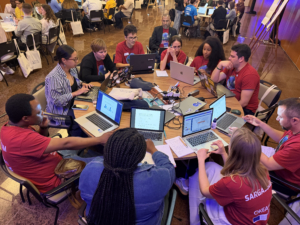
For ECOPs, one of the centrepieces of the Forum was the Intergenerational Ocean Hackathon side event, which brought together 59 ECOPs from26 countries to work in multidisciplinary teams on six challenges linked to Atlantic priorities.
Unlike a traditional conference session, hackathons challenge participants to work together under time pressure – in this case just 24 hours – to develop practical solutions to real-world problems.
Teams combined expertise from different disciplines, regions, and career stages. Marine scientists worked alongside developers, communicators, data specialists, and policy practitioners, while experienced ocean professionals provided coaching and guidance throughout the process.
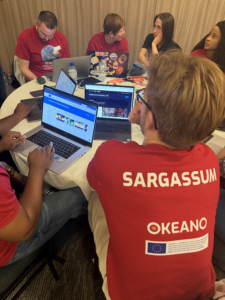
Franziska, Paola, and Winnie joined the Sargassum Challenge on monitoring and managing large-scale Sargassum blooms and their ecological and socio-economic impacts, led by GEO Blue Planet and the UNESCO-IOC Subcommission for the Caribbean and Adjacent Regions (IOCARIBE). This challenge focused on improving how near real-time monitoring data on Sargassum is communicated through the Sargassum Information Hub.
Working alongside fellow participants and experienced facilitators, the team explored how Earth observation data and scientific information could be made more accessible to different users, from fishers and tourism operators to coastal managers and policymakers.
“Our hackathon team was more than just a group of people you work with for two days,” said Franziska Elmer. “Everyone was so dedicated to our challenge and the group, and applied their unique strengths to it.”
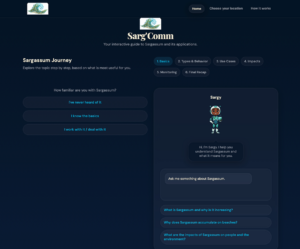
Preview of the prototype and Sargy, the AI-agent
The team’s prototype, SARG’COMM, standing for Sargassum Communication & Communities, was recognised with the Communication and Storytelling Award at the conclusion of the hackathon during the award ceremony in plenary thanks to a brilliant 7-minute pitch in front of a high-level jury. They also had the opportunity to present in a 2-minute pitch in plenary session at the All-Atlantic Forum.
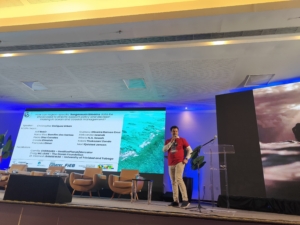
2-min pitch in plenary
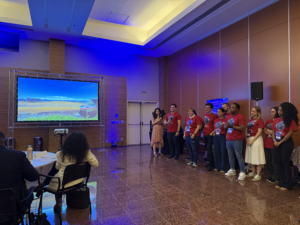
7-min pitch in front of the jury
Beyond the prototype product, the challenge provided an opportunity to develop practical skills in collaboration, communication, stakeholder engagement, and solution design. “The challenge for them as technical people, scientists, and coders and the like was to have to make a pitch and explain why their idea deserves funding,” explains Dr Craig Mclean, one of the coaches for the Sargassum team who used to be the assistant administrative for research at NOAA. “That’s a reality component of science – where you have to justify your work to society and the people who generate the money for it. But they did a marvellous job. I’m very proud of the work that they’ve done, and I think their ideas stand in high merit, and they deserve to be funded to do exactly what they developed during the course of this hackathon.”
Discover here the full story behind SAR’COMM
The All-Atlantic Forum
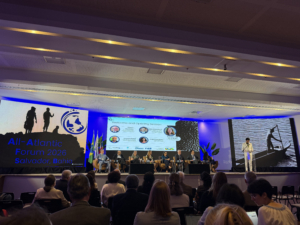
Hosted by the Brazilian Ministry of Science, Technology and Innovation and SENAI CIMATEC, the 2026 AAORIA Forum brought together governments, researchers, international organisations, and stakeholders from across the Atlantic to strengthen cooperation on ocean science and innovation.
Over the two days, the Forum focused on strengthening collaboration around ocean observation, forecasting, digital ocean technologies, marine biodiversity, sustainable blue economies, and ocean-climate action. Discussions explored how ocean science can support decision-making, improve understanding of ocean change, and contribute to sustainable development across the Atlantic basin.
For ECOPs participants, the Forum provided opportunities to engage directly with senior scientists, policymakers, and international organisations, as well as gain new knowledge.
Day one included sessions on coastal resilience, ocean observation and modelling, ocean literacy, community-based marine stewardship, and the Blue Intergenerational Programme. Discussions highlighted the expansion of the Network of Coastal Resilience Beacon Sites to include new South Atlantic sites, data gaps in the South Atlantic, progress on interoperability, and new co-design activities for under-observed tropical and subtropical Atlantic regions.
Day two focused on cross-cutting Atlantic science, the biodiversity and climate significance of the host region, sustainable aquaculture and food from the ocean, and the South Atlantic’s role in polar and climate systems.
The event also featured two ECOP-led sessions, one on “knowledge gaps of ocean science in the Atlantic,” and the other called “think global, act local: Youth-led solutions for coastal cities.”
Looking ahead
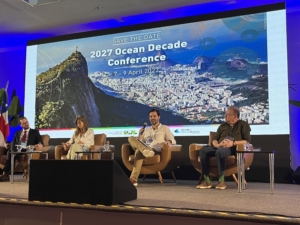
Credits: the Brazilian Ministry of Science, Technology and Innovation (MCTI), the OKEANO CSA and CNPq.
The 2026 Forum reaffirmed AAORIA’s agenda around coastal resilience, ocean observation and modelling, and sustainable aquaculture, with intergenerational collaboration running across these priorities.
For ECOPs, the discussions in Salvador showed where future opportunities for contribution may emerge. Proposed activity areas, including biodiversity conservation, marine spatial planning, food web modelling, and renewed engagement with AtlantOS, all depend on sustained scientific cooperation and strong networks across the Atlantic.
Looking to 2027, the UN Ocean Decade Conference in Rio de Janeiro, Brazil, and the next AAORIA Forum in the United Kingdom will offer further opportunities to connect early career leadership with Atlantic science, policy, and action.