
In November 2025, COP30 – the 2025 United Nations Climate Change Conference – brought governments, negotiators, and observers to Brazil to advance global climate negotiations. Against this backdrop, GEO Blue Planet and the Climate Service Center Germany (GERICS) organised a side event at the Planetary Science Pavilion to discuss better integration of coastal and ocean adaptation into National Adaptation Plans (NAP).
Moderated by Hery Wu (GERICS), the “adaptation across scales and sectors: the case for coastal and ocean adaptation” session brought together perspectives from Europe, the Pacific, and South America, and follows the release of the GEO Blue Planet/GERICS authored “Coastal and ocean adaptation. Recommendations to improve the inclusion of coastal and ocean adaptation in the development of National Adaptation Plans” supplementary material.
Jamie Ovia of the UNFCCC participated on behalf of the Least Developed Countries Expert Group (LEG), drawing on Tuvalu’s experience as a low-lying atoll nation. Professor Alexander Turra, from the University of São Paulo, represented GEO Blue Planet focusing on how ocean and satellite data can support policy decisions. Dr Louis Celliers, from GERICS, spoke about climate services as a practical bridge between science and decision-making. A sub-national perspective came from Hernán Hougassian, Provincial Director of Ecological Transition at the Ministry of Environment of the Province of Buenos Aires, Argentina.
From global frameworks to local shores
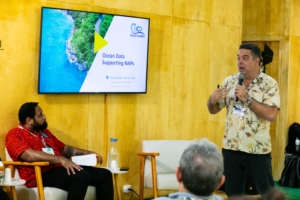
The discussions highlighted how the NAP process is a critical policy mechanism for translating climate science into national planning. Jamie Ovia explained how the revised NAP guidance draws on the latest science from the IPCC Sixth Assessment Report and aligns national planning more closely with the global goal on Adaptation.
For countries facing rising seas, storm surges, and ecosystem loss, this shift matters. Ovia described NAPs not as static documents, but as living processes that help countries move from isolated projects towards coordinated, long-term adaptation. “The naps are more than a document,” he said. “They are a bridge between global ambition and local reality.”
Professor Turra picked up that thread from a scientific angle, pointing to the growing albeit uneven availability of ocean data. Satellites, in situ instruments, autonomous vehicles, and tracking technologies are transforming how oceans are observed. Yet major gaps remain, particularly in regions such as the South Atlantic. However, more data alone, he argued, is not enough. “Data should be organised in a way that we can have actionable information that can be used.”
That translation role was central to Dr Celliers’s contribution. He described climate services as tools that turn climate data into tailored, usable products, such as supporting hazard assessments, early warning systems, monitoring, and investment planning. “The National Adaptation Planning process, and the supplementary materials…and the technical guidance is a perfect plugin point for science to support adaptation at the national level,” he said.
Taking a sub-national perspective, Hernán Hougassian described the realities of managing Buenos Aires’s long and diverse coastline. Nearly forty per cent of Argentina’s population and economic output is concentrated in the province, much of it along vulnerable coastal areas.
Hougassian outlined provincial initiatives to address erosion, restore dunes, nourish beaches, and develop an integrated coastal management plan tailored to the specific conditions of each stretch of coast. These efforts are heavily dependent on local data and scientific support, noting that “subnational governments do not necessarily have the appropriate information to support the decisions.” The situation is further complicated by limited alignment with the Federal Government, making integrated planning challenging, and local planning essential.
What comes next
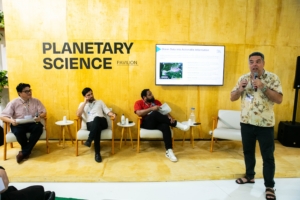
Over the course of the event, several key takeaways emerged. Participants agreed that coastal and ocean adaptation cannot succeed without sustained investment in observations, data, and climate services. They also highlighted the value of NAPs as flexible frameworks that can link global goals with national priorities and local action.
Equally important was the emphasis on process. Effective adaptation depends not only on good data but also on ongoing dialogue between scientists, policymakers, and communities, and ensuring that they are able to use data for decision-making.
Speakers pointed to the need for continued capacity-building, particularly for Least Developed Countries and Small Island Developing States. For example, LEG is preparing new guidelines for partner organisations to update thematic supplements for LDCs, while GERICS and GEO Blue Planet could provide training.
Perhaps above all, the meeting underscored a simple point. Bringing coasts and the ocean fully into NAP is no longer optional. It is essential.
Further resources
A recording of the session can be viewed on GERICS’s website